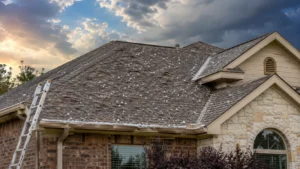
A hard Texas hailstorm can last only a few minutes. The damage it leaves behind can last much longer. Hail damage to roofs in Harker Heights is especially easy to overlook because a roof can appear perfectly normal from the driveway while individual shingles have already been bruised, cracked, or stripped of protective granules.
And that is where homeowners can get caught off guard.
You do not necessarily need water dripping through the ceiling to have roof damage. In fact, some hail-related problems develop gradually as damaged roofing materials continue to face rain, heat, sunlight, and wind.
After a strong storm, knowing what to look for matters. Here’s how hail affects asphalt shingles, what you can safely check yourself, when repairs may be enough, and when it makes sense to call a Harker Heights roofer.
How Hail Damages Asphalt Shingles
Asphalt shingles look simple, but they are made from multiple layers designed to work together.
The top surface contains mineral granules. Those granules help shield the asphalt underneath from sunlight and weather exposure. Beneath that surface is the asphalt material and reinforcing mat that give the shingle its structure.
Hail can affect all of them.
Research from the Insurance Institute for Business & Home Safety identifies several common forms of asphalt-shingle hail damage, including dents or deformation, displaced granules, and tears or cracks in the shingle. The severity depends on factors such as the hailstone’s size and impact energy, as well as the roofing material itself.
A hailstone may:
- Knock protective granules off a shingle
- Leave a soft or bruised area at the impact point
- Crack the asphalt material
- Damage the reinforcing mat underneath
- Weaken edges or corners
- Damage ridge-cap shingles
- Affect vents, flashing, gutters, and other roof components
Not every hailstone causes serious damage.
A newer roof with good-quality shingles may handle a storm differently from an older roof whose materials have become brittle after years of Texas sun and temperature changes.
Wind matters, too. Hail driven sideways by strong wind can strike different roof slopes at different angles, which means one side of your house may sustain considerably more damage than another.
That is one reason evaluating hail damage to roofs in Harker Heights requires looking at the entire roofing system rather than checking one convenient section.
Signs of Hail Damage You May See From the Ground
You don’t need to climb onto your roof immediately after a storm.
Actually, don’t.
A wet roof is dangerous, and damaged shingles can be slippery or unstable. Walking on an older roof can also create additional damage that wasn’t caused by the storm.
Start at ground level instead.
Walk around your property once conditions are safe and look for clues such as:
- Shingle granules collecting near downspouts
- Pieces of shingles in the yard
- Dented gutters
- Dents on downspouts
- Damaged metal flashing
- Marks on roof vents
- Torn window screens
- Dented garage doors
- Damaged siding
- Marks on metal patio covers or outdoor equipment
These aren’t proof that your shingles are damaged, but they can tell you something important: the hail hit your property with enough force to damage exterior materials.
If your gutters look like they’ve been struck repeatedly, your roof was exposed to the same storm.
Pay particular attention to unusual amounts of shingle granules around downspout exits after rainfall. A few loose granules aren’t automatically alarming—shingles naturally shed some material as they age—but a sudden increase following hail deserves attention.
Why Hail Damage May Not Cause an Immediate Roof Leak
This is one of the biggest misconceptions about storm damage:
“My ceiling is dry, so my roof must be fine.”
Not necessarily.
A roof is a layered system, and a damaged shingle can still shed water for some time. Even when an impact creates a weak point, you may have underlayment and roof decking beneath it preventing immediate water intrusion.
The problem can develop later.
Suppose hail removes a concentrated patch of protective granules. The asphalt underneath may then receive greater exposure to sunlight and weather.
Or hail may create a small crack that isn’t large enough to allow significant water through today. Continued heating and cooling can stress that area. Wind may lift it. Another storm may make it worse.
Eventually, what started as a relatively small weakness can become a path for moisture.
IBHS notes that severe hail damage can create the potential for water entry, particularly when impacts tear or breach asphalt shingles.
That’s why hail damage to roofs in Harker Heights should be evaluated based on the condition of the roofing materials, not simply on whether water is currently entering the house.
When Should You Schedule a Roof Inspection After a Hailstorm?
Not every afternoon thunderstorm requires a professional roof inspection.
A significant hail event is different.
Consider scheduling an inspection if:
- Large or forceful hail struck your property
- Your gutters have fresh dents
- Shingle granules suddenly appear around the home
- Roofing debris is scattered in your yard
- A section of shingles looks different after the storm
- Your roof is already older
- You see ceiling stains or attic moisture
- Nearby homes appear to have roof damage
- Wind accompanied the hailstorm
Timing matters.
You don’t need to panic and sign a roofing contract the morning after a storm. You should, however, avoid ignoring potential damage for months while additional weather continues to affect the roof.
A proper inspection gives you a documented picture of the roof’s condition.
That is useful even if the conclusion is good news: no significant damage and no immediate work required.
Hail Damage vs. Normal Roof Wear
One challenge with hail damage to roofs in Harker Heights is separating storm-related impact damage from ordinary aging.
Roofs don’t stay new forever.
Texas sunlight, wind, temperature changes, rain, debris, and years of normal exposure gradually change asphalt shingles. Granule loss can happen naturally. Colors can fade. Edges may curl. Older shingles can become brittle.
Hail damage tends to look different.
Professional roof evaluations consider the location, shape, pattern, and surrounding context of damage. IBHS inspection guidance specifically recommends distinguishing hail-related patterns from aging, weathering, maintenance issues, foot traffic, and other mechanical damage.
Here’s a useful comparison:
| Roof Condition | Hail Damage | Normal Wear |
|---|---|---|
| Pattern | Random impact points | Usually gradual and widespread |
| Granule loss | Concentrated around impacts | More uniform thinning |
| Timing | Appears after a particular storm | Develops gradually |
| Cracks | May correspond with impact points | Often related to age and deterioration |
| Metal components | Fresh dents may also appear | Usually unaffected by roof aging |
| Distribution | May be heavier on exposed slopes | More consistent with long-term exposure |
This distinction is important because not every mark on a roof was caused by the most recent storm.
A qualified roofer should look at the evidence as a whole.
What to Photograph After a Hailstorm
Your phone is one of the most useful tools you have after severe weather.
Document the property before cleanup begins whenever it is safe to do so.
Start with the hail itself.
If hailstones are still present, photograph several beside a ruler, measuring tape, coin, or another familiar object that clearly shows scale. Take both close-ups and wider photographs showing hail across the yard, driveway, deck, or landscaping.
Then photograph exterior damage.
Useful photos can include:
- Dented gutters
- Damaged downspouts
- Torn screens
- Damaged siding
- Roof debris on the lawn
- Shingles visible from the ground
- Damaged fences
- Outdoor HVAC equipment
- Patio covers
- Vehicles damaged by the same storm
- Tree limbs that struck the house
- Interior ceiling stains or moisture
Take more than one angle.
One close photograph may show the damage clearly, while a wider photograph establishes where that damage is located on the property.
Don’t throw damaged roofing material away immediately if shingles or pieces of flashing have landed in the yard. Photograph them first.
Good documentation creates a much clearer record of what happened and when.
Can Hail-Damaged Shingles Be Repaired?
Sometimes.
Hail damage to roofs in Harker Heights does not automatically mean the entire roof needs replacement.
If damage is genuinely isolated, individual shingles or a limited roof section may be repairable.
Repair tends to be more practical when:
- Only a small area was affected
- Surrounding shingles remain in good condition
- The roof is relatively young
- Matching replacement shingles are available
- Removing damaged shingles won’t harm adjacent materials
- The underlying decking and roofing system remain sound
Age complicates things.
Older asphalt shingles often become less flexible. Trying to lift one shingle to replace another can crack or disturb neighboring materials.
Matching can also be difficult.
Even if the original product is still manufactured, years of sun exposure may mean a brand-new replacement shingle looks noticeably different from the existing roof.
That doesn’t necessarily prevent a repair, but it should be considered before work begins.
When Roof Replacement May Be Necessary
Then there are storms where isolated repairs simply don’t make sense.
Replacement may become the more reasonable option when damage extends across a substantial portion of the roof, numerous shingles have been compromised, or the roof was already nearing the end of its practical service life.
Warning signs can include:
- Widespread impact damage
- Significant granule displacement
- Numerous cracked or fractured shingles
- Damage across multiple roof slopes
- Damaged ridge caps
- Existing deterioration combined with new hail impacts
- Extensive repair areas
- Compromised roofing material around penetrations or flashing
The decision should be based on the roof as a system.
Replacing three visibly damaged shingles doesn’t accomplish much if dozens of surrounding shingles have also been weakened.
Likewise, replacing an entire roof because of one small damaged area may be unnecessary.
The right answer depends on severity, distribution, age, material condition, repairability, and what the inspection actually shows.
Common Mistakes Homeowners Make After Hailstorms
Storms create urgency, and urgency can lead to poor decisions.
Avoid these common mistakes.
Assuming no leak means no damage
We’ve already covered this one, but it’s worth repeating.
A dry ceiling today doesn’t guarantee an undamaged roof.
Climbing onto the roof yourself
You may be comfortable on a ladder. A sloped roof is different.
Wet shingles, loose granules, hidden damage, and steep slopes create unnecessary risk.
Waiting too long to investigate
Ignoring suspected hail damage to roofs in Harker Heights can allow relatively small vulnerabilities to experience months of additional weather.
Inspect early. Decide what to do after you know the condition.
Signing something immediately
After major storms, roofing companies may move quickly through affected neighborhoods.
There is nothing wrong with speaking to contractors, but understand exactly what you’re signing before authorizing work.
Choosing solely by price
The lowest estimate isn’t automatically the best value.
Compare the actual scope: materials, flashing, ventilation, underlayment, cleanup, workmanship coverage, and what happens if damaged decking is discovered.
Fixing only what you can see
A dented gutter is obvious.
A compromised shingle mat isn’t.
Exterior clues should trigger a closer evaluation of the roofing system rather than assuming cosmetic damage is the whole story.
What a Professional Roof Inspection Should Cover
A useful hail inspection is more than someone walking around for five minutes and announcing that you need a roof.
Expect a systematic evaluation.
The roofer may examine:
- Shingle surfaces
- Ridge caps
- Roof valleys
- Flashing
- Pipe penetrations
- Roof vents
- Gutters and downspouts
- Other metal components
- Areas where debris may have struck
- Roof edges and transitions
When appropriate, the attic can also be checked for signs of moisture intrusion, damaged decking, or other concerns.
Photographs are valuable here.
Ask to see what was found.
A homeowner shouldn’t have to take someone’s word for it when the damage can be documented and explained.
Repair or Replace? A Quick Decision Guide
Every roof is different, but this table gives you a starting point.
| Situation | Possible Next Step |
|---|---|
| A few isolated damaged shingles | Targeted repair may be possible |
| Widespread impact marks | Schedule a complete roof assessment |
| Older roof with new hail damage | Compare repair and replacement realistically |
| Interior leak after the storm | Arrange prompt inspection |
| Fresh dents on gutters and vents | Have the roof checked for corresponding impacts |
| No visible damage but substantial hail occurred | Consider a preventive inspection |
| Large areas of damaged shingles | Evaluate whether replacement is more practical |
Notice the language here: may, consider, evaluate.
Roofing decisions should come from evidence, not assumptions.
Protecting Your Roof Before the Next Storm
You can’t stop hail from falling.
You can reduce the number of existing weaknesses your roof carries into the next storm.
Keep gutters clear so rainwater can leave the roof efficiently. Replace missing or visibly damaged shingles rather than postponing basic repairs. Keep branches from scraping against or falling onto the roof.
Pay attention to flashing, too.
Small problems around chimneys, vents, walls, and other roof penetrations can become much more noticeable during severe weather.
It’s also useful to keep photographs of your roof and exterior before storm season.
That gives you a baseline.
If a major storm occurs later, you’ll have something to compare against.
When to Call a Harker Heights Roofer
You don’t need to call a roofer after every rumble of thunder.
But when significant hail strikes your neighborhood, a roof inspection can remove a lot of uncertainty.
Call a Harker Heights roofer when you find dented gutters, unusual granule accumulation, loose shingles, roof debris, interior moisture, or other evidence that the property took a hard hit.
You should also consider an inspection when the roof is older and has been through another severe storm, even if you’re not seeing an active leak.
A professional Harker Heights roofing inspection should answer straightforward questions:
What was damaged?
How extensive is it?
Can it be repaired?
Does anything require immediate attention?
And what can safely be left alone?
Those answers are far more useful than assuming every storm requires a new roof—or assuming everything is fine because the ceiling is still dry.
Don’t Ignore Possible Hail Damage
Hail damage to roofs in Harker Heights can be obvious. Sometimes shingles are missing, gutters are battered, and leaks appear almost immediately.
Other times, it is subtle.
A few concentrated areas lose granules. A shingle develops a small fracture. A vulnerable section continues shedding water successfully until another round of severe weather exposes the weakness.
That’s why a sensible response after a hailstorm is neither panic nor neglect.
Document what happened. Walk around the property safely. Look for damage to roofing-related components and other exterior surfaces. Photograph anything unusual. Then arrange a professional evaluation if the storm was significant or the evidence suggests your roof was affected.
If you suspect hail damage to roofs in Harker Heights, Harker Heights Roofs can inspect your roofing system, explain what we find, and help determine whether a targeted repair or a larger roofing project makes sense.
The important part is knowing what you’re dealing with.
Once you know that, you can make the next decision with confidence.